I. PURPOSE
The purpose of this guideline is to define policies and procedures that will ensure compliance with the Commonwealth of Massachusetts Board of Fire Prevention Regulations, 527 CMR and the Commonwealth of Massachusetts State Building Code, 7th Edition, 780 CMR, codes and local city regulations as they apply to ensure fire and life safety for events that occur inside a Tufts University building attended by three hundred (300) or more persons. This guideline does not apply to academic classes.
II. SCOPE
Whenever three hundred (300) or more persons attend an event inside a Tufts University property that is being used as a venue other than what it is primarily intended (ie: Gantcher Center; Cousens Cage, Campus Center) the individual sponsor, or a representative of the sponsoring organization, must review this guideline prior to the event and assure compliance with the specified guidelines before, during, and after the event.
III. APPLICATION
This guideline applies to individuals and the representatives of organizations who sponsor events that take place inside University buildings.
IV. DEFINITIONS
Authority Having Jurisdiction (AHJ) – The AHJ shall be the State Fire Marshal and the Chief of the local Fire Department where the event is being conducted. The Tufts University Fire Marshal is responsible for enforcing University policy and guidelines.
Code – The term “code” shall mean the NFPA 101 Life Safety Code which serves as a primary reference for life safety issues in the Commonwealth of Massachusetts.
Means of Egress – A continuous and unobstructed path of travel from any point in a building or structure to a public space and consists of three (3) separate and distinct parts:
- the exit way access;
- the exit way; and
- the exit way discharge.
A means of egress comprises the vertical and horizontal means of travel and shall include intervening room spaces, doors, hallways, corridors, passageways, balconies, ramps, stairs, enclosures, lobbies, escalators, horizontal exits, courts, and yards.
Exit – The term “exit” shall have the same meaning as “means of egress”.
Net Floor Area – Represents the total floor area of an EMPTY room.
Occupancy – The term “occupancy” shall mean the use of space or room(s) within a building by a person or group of persons.
Place of Assembly – The term “place of assembly” shall mean a room or space within a building in which more than fifty (50) persons assemble for religious, recreational, educational, political, fraternal, social or amusement purposes, or for the consumption of food or drink.
V. PROCEDURES
1. General Requirements
The following procedures are established to assure compliance with the State Board of Fire Prevention Regulations and State Building Codes and the Tufts University Fire and Life Safety guidelines during events in places of assembly on campus. The event sponsor is responsible for complying with the University’s Crisis Management Plan. Every employee should be familiar with the University’s Crisis Management Plan. Important safety information and emergency procedures are detailed in the Tufts Department of Public Safety website: http://www.publicsafety.tufts.edu
2. Responsible Person
Designate a person from your organization who will be responsible for complying with all applicable requirements specified in the Fire and Life Safety for Events Checklist. The responsible person shall attend and be present throughout the duration of the event to assure compliance with all specified guidelines and procedures.
3. Planning the Event
Determine the occupancy capacity of the space you plan to reserve for your event. The space must be large enough to accommodate the expected number of attendees. The listed occupancy capacity assumes no furnishings in the room. The use of chairs, tables, bars, stages, etc. will reduce the capacity of the space.
4. Decorations, Wall Coverings or Sound Insulation
All decorations, wall coverings and sound insulation must be flame resistant, as specified in the State Board of Fire Prevention Regulations. A Permit for Use of Decorative Materials must be submitted to the Tufts Fire Marshal prior to the event.
The permit shall specify:
- the material that has been certified as flame retardant;
- the certifying agency;
- certification number; and
- the type of occupancy that the permit is being issued.
Decorations: “shall not obstruct exits, access thereto, egress therefrom, or visibility thereof”.
Decorations: “shall not be placed over exit doors or otherwise be located to conceal or obscure any exit”.
Contact the Tufts Fire Marshal’s Office with any questions concerning the flammability of materials intended to be used in the space.
5. Fire Fighter Detail
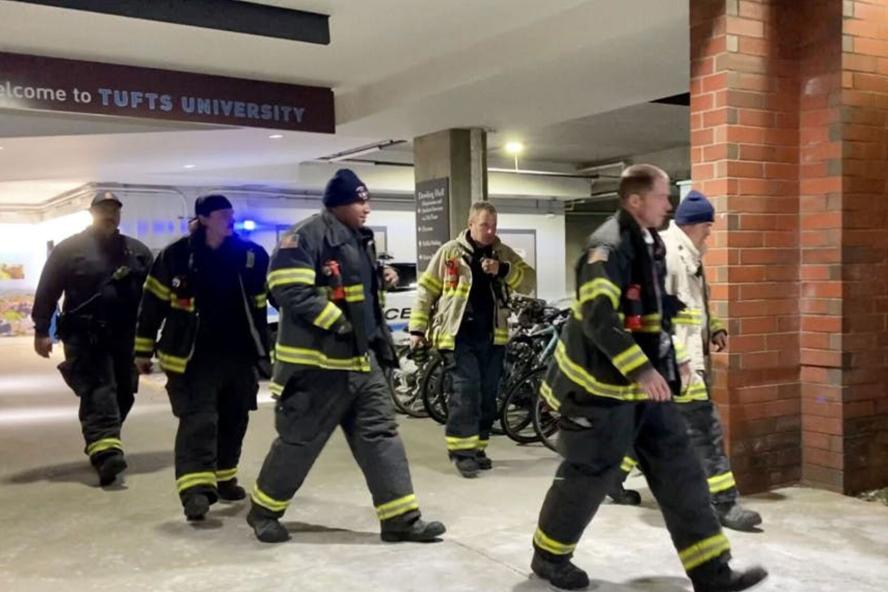
Venues which will be used for events other than its intended use (generally the effected venues are Cousens Cage, Gantcher Center, Campus Center) and will have an expected attendance of 1,000 or more, a firefighter detail may be required. The event planner must contact the Tufts Fire Marshal, 617-627-3922, at least two (2) weeks prior to the event to review the requirements and to request a local Fire Department firefighter detail, if deemed necessary. The cost of the detail is the responsibility of the event sponsor. An IDR must be submitted to the Tufts Fire Marshal before the fire fighter detail will be scheduled. Contact Tufts Fire Marshal for current rates.
6. Open Flames and Pyrotechnic Devices
The use of open flames, candles or pyrotechnical devices are strictly prohibited inside any University building. Persons requesting candles for religious ceremonies should consult with their religious advisor.
7. Fire-Safe Flameless Candles
Flameless, battery operated, real wax candles are available and may be used at events. They operate for 350 hours on two “C” size batteries. On the interior of the candle is an LED bulb which creates the warm glow and random flicker of authentic candlelight. Product information on these candles may be found at www.cfsi.org/candles .
8. Tables, Chairs and Aisles
In each place of assembly where seating is provided, except where assembly is seated at tables, the seating shall be arranged in an orderly manner with ample provisions made for aisles leading to exits, and no aisle forming a part of the egress system of the place of assembly shall be obstructed or encumbered. Tables arranged for dining or other purposes in places of assembly shall be so located in respect to exit openings, and so spaced apart, that sufficient means of access to exit openings is provided. Aisles in the direction of exits shall be at least three feet (3’) in width. Suitable access to aisles shall be provided from all tables. For more detailed information refer to NFPA 101, Life Safety Code, Section 13.2.5.5, 2009 Edition.
9. Sterno Gel Fuel for Food Warming
Sterno type gel fuel may be used for food warming at approved events, as long as the following guidelines are adhered to:
- A trained attendee with access to a type “ABC” portable fire extinguisher must be present whenever Sterno type gel fuel is used.
- Never use water to extinguish a fire involving Sterno type gel fuel since water may actually spread the fire.
- No combustible materials (paper, baskets, table decorations, table linens, etc.) may be placed within six (6) inches of a burning fuel container.
10. When Working with Sterno Gel Fuel:
• Use CAUTION when handling OPEN FLAME products.
• Use a blunt object, such as a spoon, to pry off the lid.
• Cup hand over lid when opening the can.
• Remove excess gel from lid if it is being used as a regulator.
• Wash fuel residue from hands.
• Place the can underneath the chafing dish or beverage urn before lighting.
• Make sure the cans are placed securely in the equipment.
• Use a long handled match or butane lighter to light the can.
• Use a snuffer paddle, regulator or saucer to extinguish the flame.
• Wait until the can is cool before touching.
11. When Working with Sterno Gel Fuel, DO NOT:
• Use a sharp knife to pry off the lid
• Use a lit can to light another can
• Carry lit cans
• Carry chafing dishes or beverage urns with lit cans
• Touch cans while still hot
• Allow loose clothing, napkins or tablecloths near flame
• Allow hair to fall near flame
• Use hands to extinguish flame
• Blow out flame of Sterno type gel fuel to extinguish
Small amounts of Sterno gel type fuel shall be stored in closed containers in a cool dry place (40-120°F) away from sources of heat or open flame. If large amounts of Sterno gel type fuel is to be stored in a University building please contact the Fire Marshal’s Office to determine appropriate storage requirements. For more information about Sterno type gel fuel education and safety, please refer to the following website: http://www.sterno.com/education and saferv.asyx?kwid=l&descid=2&p education and safetv.aspx
12. 90 Minutes Prior to the Start of the Event:
- Check the panic hardware on all exit doors to assure smooth operation.
- Open all exit doors to check the door swing, and remove any obstructions. During winter weather assure that snow and ice have not created an obstruction.
- Check to make sure that any handicapped accessible entrances are unlocked and unobstructed.
- Confirm that there are at least two clear exits.
- All corridors, stairways, and egress passageways must be clear and unobstructed.
- Fire doors must never be blocked open or chained shut.
- Confirm that exit signs are present, visible and appear to be operating properly.
- Confirm that emergency lights are operational.
- Confirm that adjoining spaces present no obvious fire hazards.
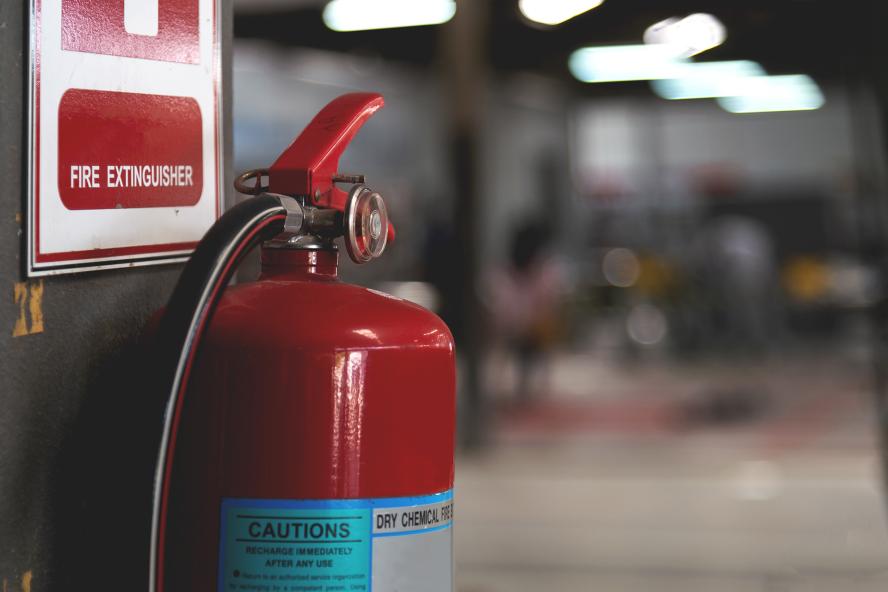
- Fire extinguishers must be available for use. Check to be sure the pressure gauge is in the green zone and a current inspection tag is attached.
- Know the location of manual fire alarm pull stations and assure that they are visible and easily accessible.
- Contact Facilities Work Control to correct any deficiencies or obstructions.
13. Fire Alarm Evacuation Announcement
The following announcement must be made at the start of the event, and between musical sets:
“In the event of a fire alarm, please proceed calmly to your nearest exit, leave the building and move away from the building. Please note the location of the nearest exit to you. Be aware that the way you entered the building may not be the closet way out. Sitting or standing in the aisles and doorways is not permitted. Smoking is not allowed inside any University building. Please turn off or silence all pagers and cell phones. Thank you and enjoy the performance.”
14. During the Event
- Ensure that the occupancy capacity of the space has not been exceeded.
- Continue to monitor all exits, halls and stairways to be sure they are remaining clear and unobstructed.
- Ask anyone blocking an aisle or a doorway to move.
15. After the Event
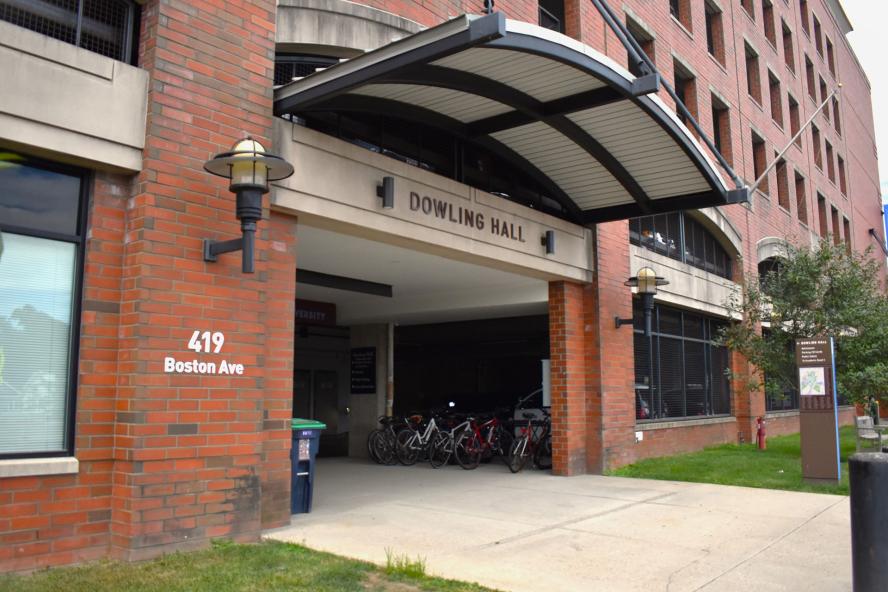
At the completion of the event, the responsible person shall complete and sign the Event Fire and Life Safety Checklist to verify that all appropriate fire safety procedures were accomplished. Send the completed checklist via campus mail to the Fire Marshal, Dowling Hall, Medford.
16. Assembly Occupancy Capacity Calculations
Occupancy capacities have been calculated by the Tufts Fire Marshal and are subject to change, based on inspections by the local Fire Department, under provisions of the State Building Code, 7th Edition. Occupancy capacity of a room is based on the net square footage of unobstructed available floor space.
- The “Net Floor Area” is based on an observation of the room configured for normal usage. Usually the “Net Floor Area” represents the total floor area of an empty room. However, if the room contains a stage, a display case, a bar, a large table or chair, or any other permanent or semi-permanent fixture, the space occupied by the obstruction must be subtracted from the total area of the room to arrive at the “Net Floor Area”.
- “Concentrated Use” capacities are based on the number of people standing in a room, and are calculated at seven (7) square feet of “Net Floor Area” per person. This use applies to functions. Tables, chairs, stages, bars or any other furnishing placed in the room will reduce the capacity by one (1) person for every seven (7) square feet of floor space taken up by the furniture.
- “Less Concentrated Use” capacities assume that people are seated at tables.
- “Non-Fixed Seating” refers to chairs that are easily removed from the room. Folding chairs and table chairs in classrooms are examples of “Non-Fixed Seating”.
- “Fixed Seating” refers to seats in auditoriums or gymnasiums, where the seats or bleachers are permanently affixed to the floor.
- “Dance Functions” require ten (10) square feet per person of Net Floor Area.
VI. RESPONSIBILITIES
1. Event Sponsors
- Groups that sponsor events in University buildings must appoint a responsible person whenever attendance at the event will exceed 100. That person must be familiar with the University’s Emergency Crisis Management Plan. The Tufts University Department of Public Safety website http://www.publicsafety.tufts.edu has links to Emergency Preparedness.
- The responsible person must also complete the Event Fire and Life Safety Checklist. The checklist is available on-line here .
- The responsible person must contact the Tufts Fire Marshal’s office to determine if a local Fire Fighter Detail is required for the event. An IDR must be submitted to the Tufts Fire Marshal at least ten (10) business days prior to the date of the event to schedule the detail and to cover the costs.
- The responsible person shall perform an inspection of the space before the start of the event using the checklist and be present throughout the duration of the event to assure compliance with the Event Fire and Life Safety guidelines.
- If Food Warming is required, ensure that the guidelines for the safe use of Sterno type gel fuel are followed as described in Section V, items 9, 10 and 11 in this guideline.
- At the completion of the event, the responsible person shall complete and sign the Event Fire and Life Safety for Events Checklist to verify that all appropriate Fire Safety Guidelines have been accomplished. Forward the completed checklist to the Fire Marshal, Dowling Hall, Medford.
2. Facilities
- Assure that the set-up of tables and chairs is done in accordance with fire code specifications as referenced in Section V of this program.
- Be responsible for the maintenance of life safety equipment (emergency lighting, exit signs, doors and emergency hardware).
3. Fire Safety – Tufts Fire Marshal
- Provide training regarding the implementation of this program.
- Schedule local Fire Department Firefighter details upon request and submit IDR and Requisition to Accounts Payable.
- Assist with Crowd Management for significant University events upon request.
- Review the policy annually and update as needed.
- Maintain a list of capacities for all assembly areas.
4. Public Safety – Tufts University Police
Many events held in University spaces may require a police detail. Typically, an event where there are 100 persons or more in attendance and alcohol is being served, a detail is required. The event sponsor should notify the Tufts Police (daytime supervisor) to inquire if a detail is necessary and if so, submit an IDR for the detail officer(s). Many other events often require police details including controversial speakers, large student events, large events open to the general public, etc. Again, event organizers should contact the Tufts Police to inquire about the need for a police detail.
VII. REFERENCES
National Fire Protection Association, NFPA 1 – The National Fire Prevention Code,2009
National Fire Protection Association, NFPA 101 – The Life Safety Code, 2009
Commonwealth of Massachusetts Board of Fire Prevention Regulations, 527 CMR
Commonwealth of Massachusetts General Laws, Chapter 148
Commonwealth of Massachusetts State Building Code, 7th Edition
Candle Corporation of America
Sterno – Education and Safety website, January 2007